
Evidence Management:
Protecting the Chain of Custody
This scenario-based eLearning training was developed to mitigate critical procedural failures in evidence handling and chain-of-custody protocols that threatened the viability of active criminal cases.
Audience: All law enforcement officers, regardless of sworn status.
Responsibilities: Instructional Design, eLearning Development, Visual Design
ToolsUsed: Articulate Storyline, MindMeister, eLearningArt, Google Slides, ChatGPT, Google Gemini, Canva, Unsplash
Note: This project is a simulated training course created for portfolio demonstration purposes. Evaluation data reflects modeled outcomes based on realistic performance benchmarks.
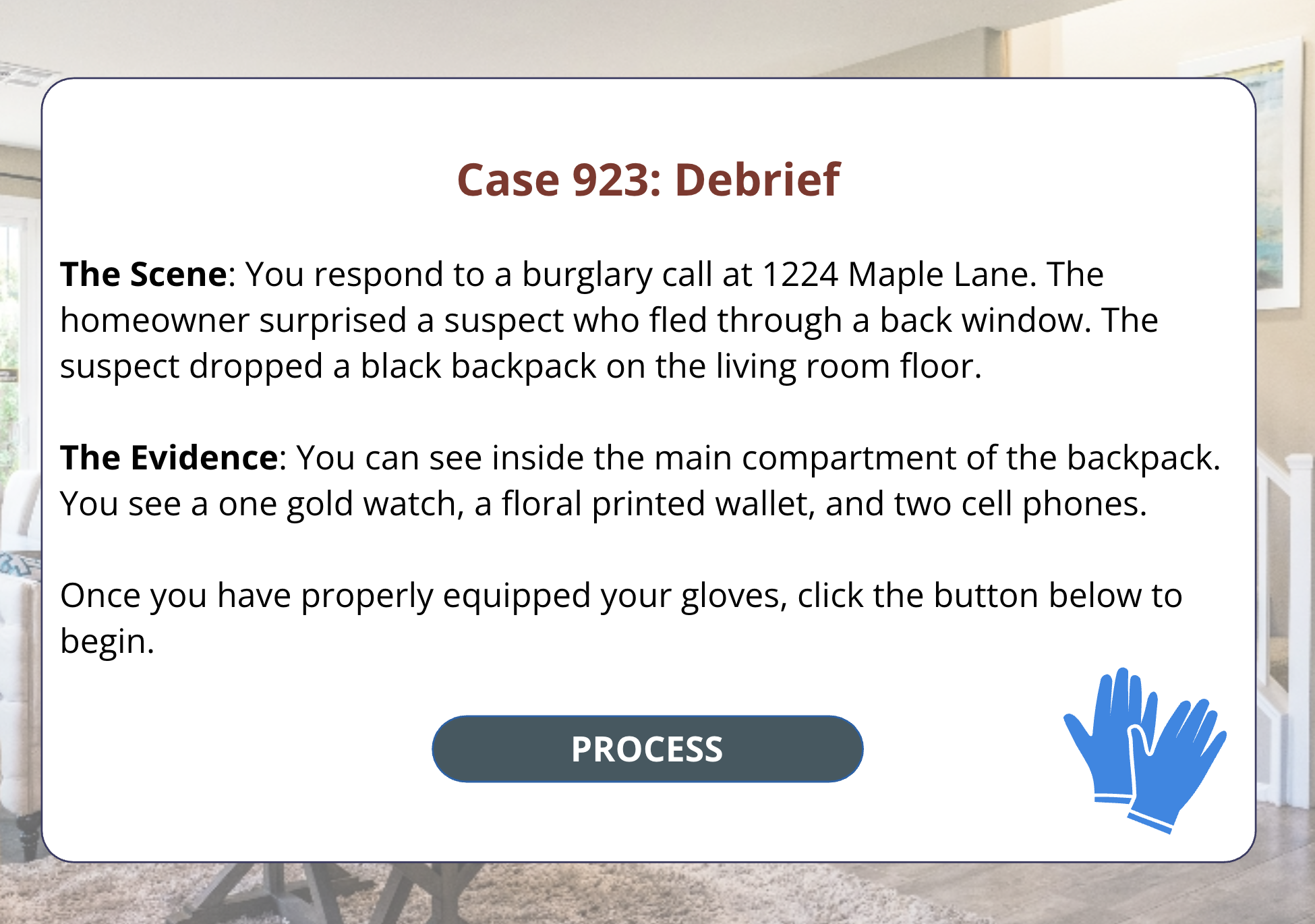
The Problem
Inconsistent collection and submission habits among officers had led to significant documentation errors, compromising forensic integrity and creating a massive administrative bottleneck for Crime Scene Investigation (CSI) staff. By establishing a rigorous, accountability-focused training framework, this course ensures that evidence is handled with precision, submission workflows remain efficient, and case preparation stands up to legal scrutiny.
The Solution
The primary design challenge was to create a high-impact learning experience for all levels of sworn law enforcement. While this audience was large, it was crucial that I understood that this audience is notoriously "time-poor" and resistant to redundant training, no matter their experience level. Recognizing that many of these officers already possess foundational knowledge, I bypassed traditional lecture-style content in favor of a "test-then-tell" instructional strategy. This approach places learners directly into high-stakes, realistic simulations where they must apply their existing judgment and adapt to new organizational standards in real-time.
The core of the course is built around three immersive case studies: Currency (Burglary), Narcotics, and Firearms, which were identified by my subject matter expert (SME) as the categories most prone to evidence rejection.
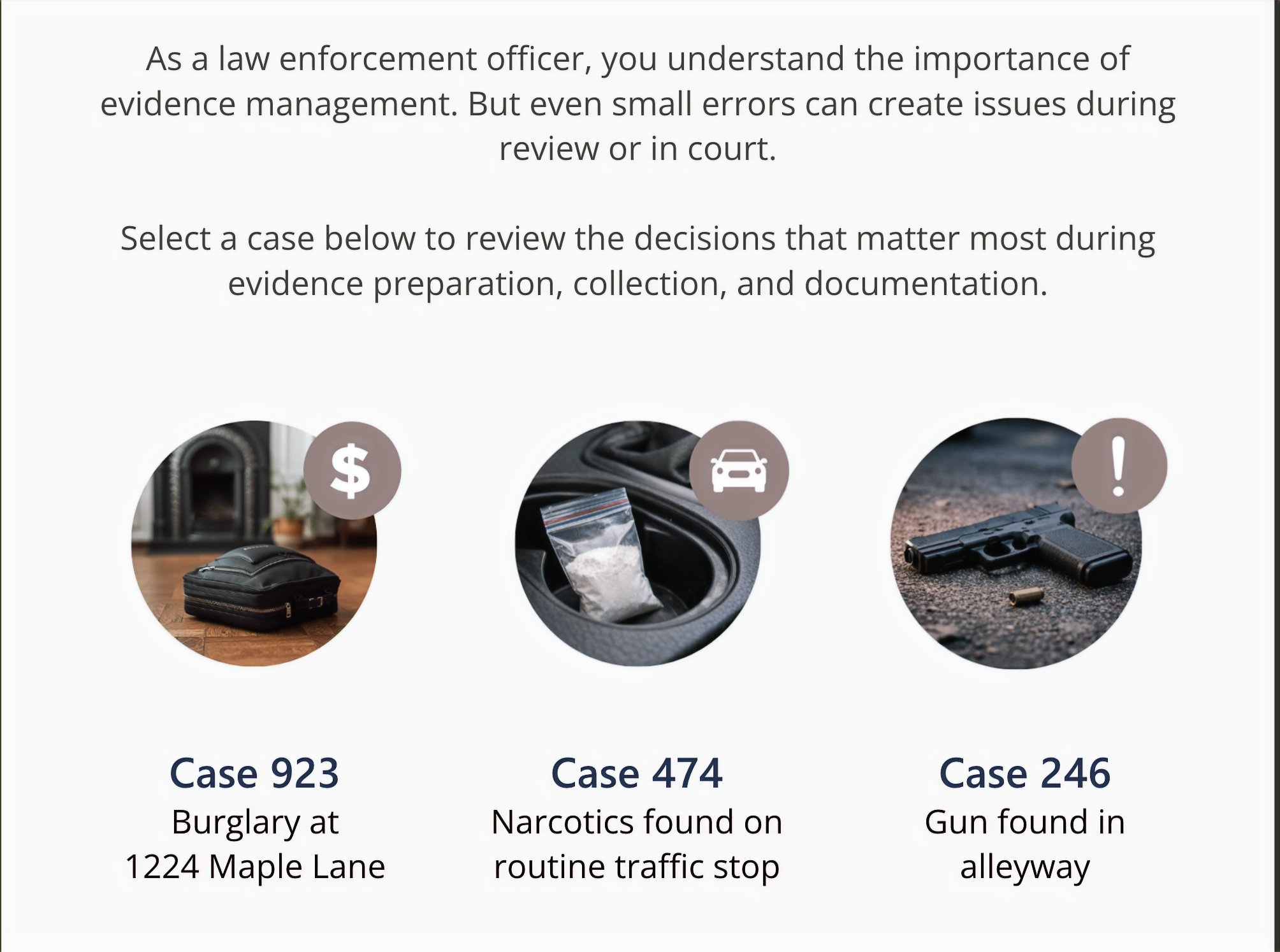
Case menu screen where learners select their preferred scenario to practice targeted skills.
Design choices centered around:
Immersion-Based Decision Making: I eliminated passive "teaching" blocks. Just as they would in the field, learners are dropped into a scene and must rely on their training and available tools to proceed. If a learner reaches a point of uncertainty, they are encouraged to be resourceful by referencing a digital evidence management handbook or "calling" a virtual Field Training Officer (FTO) for guidance.
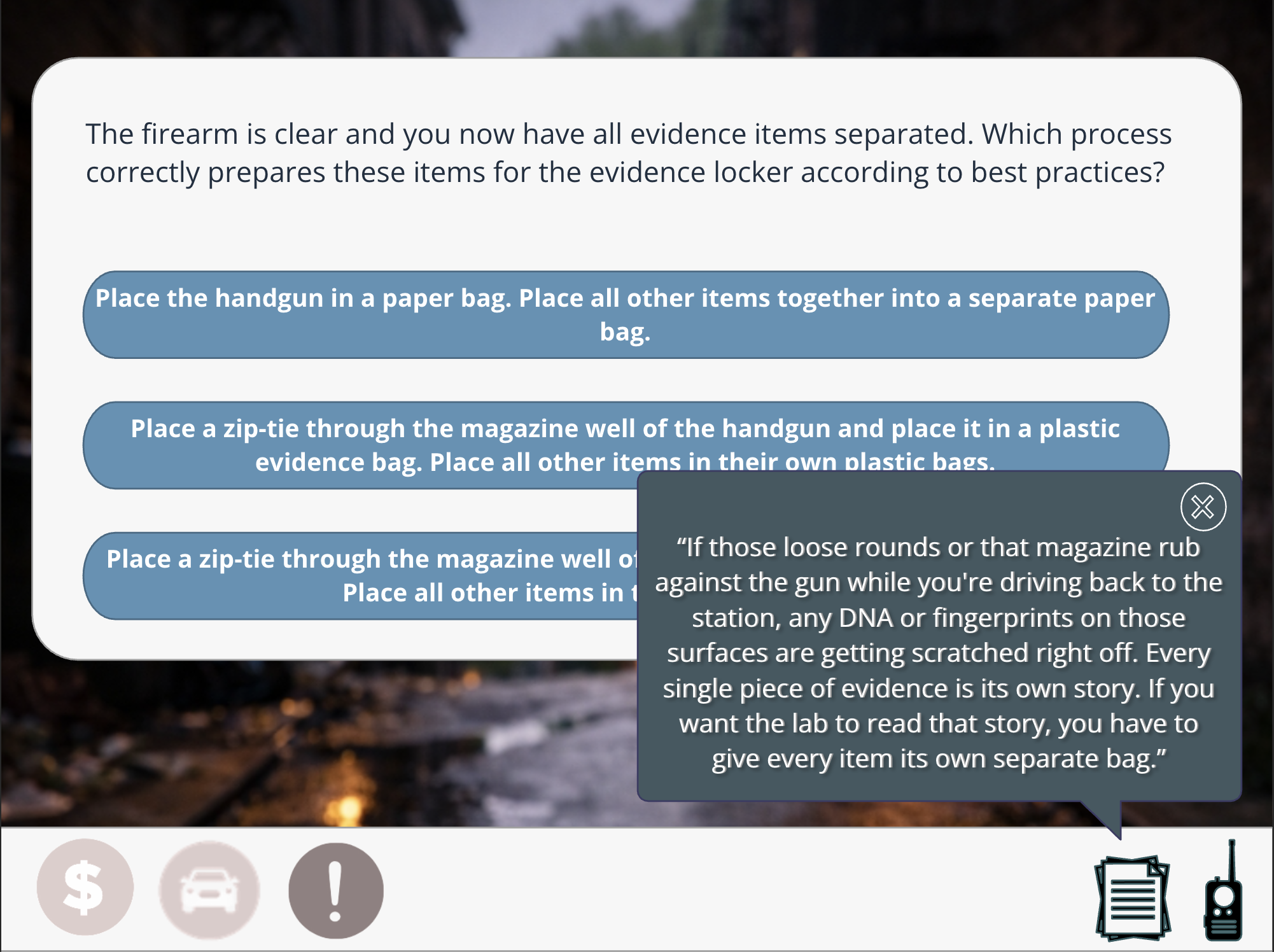
A sample screen with the FTO help dialogue layer active.
Targeting "Failure Points": The interactivity focuses specifically on the technical decision points where errors most frequently occur, such as specific packaging requirements for biohazards or the nuances of documenting large sums of currency. This ensures the training directly mitigates the most common causes of evidence rejection.
Building Professional Self-Efficacy: By forcing learners to navigate complex, branching paths, the course builds the habit of referencing current department policy, ensuring that their confidence is backed by procedural accuracy rather than just memory.

A sample screen of constructive feedback for an incorrect answer.
To ensure absolute forensic and instructional integrity, the curriculum underwent a rigorous review process by a CSI evidence manager with 7 years of experience and my CSI technician SME with 14 years of experience. The design received full validation with no requested changes to the content or flow, confirming its relevance to modern policing.
Evaluation & Impact
Evaluation was structured using Kirkpatrick Levels 2–4 to measure both learning and real-world performance outcomes.
Level 2 - Learning
Learning was measured through a series of scenario-based multiple-choice assessments designed to evaluate comprehension, procedural application, and the decision-making processes required for evidence integrity.
Each assessment incorporated targeted feedback loops. When learners selected incorrect responses, they received corrective feedback and were prompted to revisit the question with guidance on where to locate the relevant departmental policy.
This formative structure reinforced resource utilization and procedural reasoning, encouraging learners to reference official standards rather than relying on guesswork.
Level 3 - Behavior
Three months after course completion, a follow-up evaluation measured the consistency with which evidence integrity standards were applied in field operations.
Learner Self-Assessment:
Approximately 90% of participants reported high confidence in applying course procedures, frequently referencing the departmental handbook or consulting with Field Training Officers (FTOs).
Observational Data:
CSI personnel and FTOs used a standardized observation checklist aligned with course objectives to monitor field behavior.
Observations indicated a 25% decrease in procedural errors and non-compliance incidents compared to pre-training benchmarks.
Level 4 - Results
The primary organizational objective was to achieve a 30% reduction in evidence processing errors and CSI resubmissions within three months of implementation.
Performance data was extracted from the CSI Evidence Management System and compared against baseline submission quality from the previous quarter.
Analysis revealed a 27% decrease in non-compliant submissions and CSI rejections, demonstrating measurable improvement in evidence handling practices following training.