
The Parent-Teacher Playbook:
Navigating Phone Calls with Confidence
This scenario-based eLearning course was designed to address a common barrier to effective family engagement: teacher anxiety around parent phone communication. The training introduces a structured communication framework that helps educators prepare for difficult conversations, maintain a constructive tone, and document interactions professionally.
Audience: K–12 Educators
Responsibilities: Instructional Design, eLearning Development, Scenario Design, Visual Design
Tools Used: Articulate Rise, Canva, Google Slides, ChatGPT, Google Gemini, Unsplash
Note: This project is a simulated training course created for portfolio demonstration purposes. Evaluation data reflects modeled outcomes based on realistic performance benchmarks.

The Problem
Many educators experience significant anxiety when communicating with families by phone. As a result, teachers often rely on written communication methods or delay outreach, which can reduce opportunities for proactive family engagement.
While professional development frequently emphasizes the importance of family communication, teachers are rarely provided with structured frameworks or practical strategies for conducting phone conversations with confidence. Without clear guidance, communication with families can become inconsistent, reactive, or avoided altogether.
The goal of this project was to design a training experience that would help educators develop confidence, structure, and consistency in parent phone communication.
The Solution
To address this challenge, I designed a scenario-based eLearning course that introduces educators to a structured framework for preparing, conducting, and documenting parent phone conversations.
The course was developed in Articulate Rise to ensure accessibility for busy educators. Its mobile-responsive layout allows teachers to engage with the material during short planning periods or outside of school hours, accommodating the limited and inconsistent computer access common in many school environments.
The instructional strategy focuses on guided practice through realistic scenarios. Rather than presenting communication strategies through lecture-style content, the course places learners in common school communication situations where they must analyze context, select appropriate responses, and reflect on the impact of different approaches.
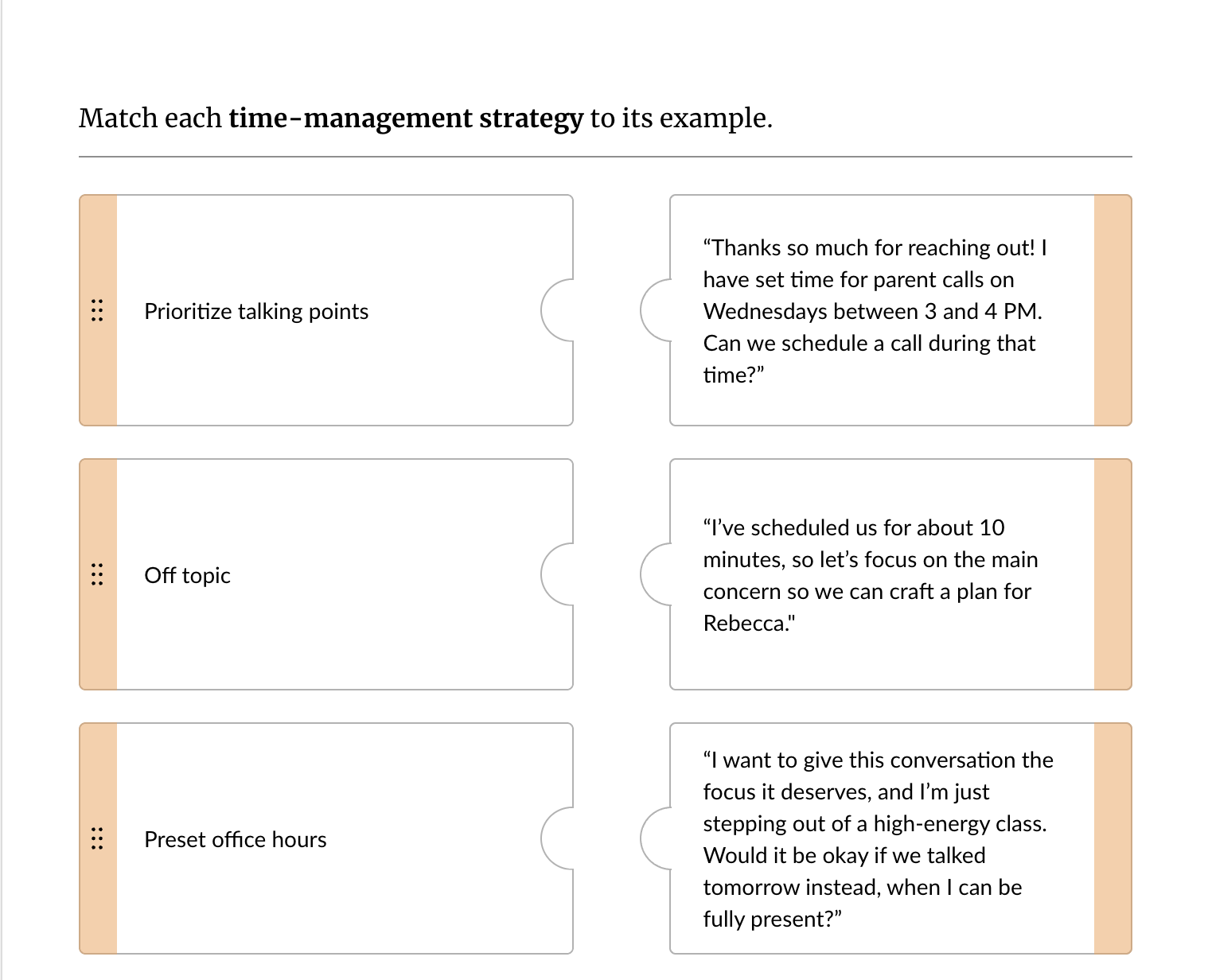
Sample screen illustrating a matching activity where learners matched time management strategies to their real-world examples.
Design choices centered around:
Scenario-Based Practice
Learners work through realistic communication scenarios using interactive elements such as hotspots, tabs, and click-to-reveal activities. These interactions simulate situations such as addressing academic concerns, delivering constructive feedback, or navigating emotionally charged conversations with families. By exploring multiple response options, learners practice applying communication strategies in context.
Guided Feedback Loops
Each interaction provides immediate, targeted feedback explaining why specific communication approaches are effective or ineffective. These feedback loops reinforce best practices for maintaining professionalism, clarity, and empathy during parent conversations.
Structured Communication Framework
The course introduces a repeatable structure that guides teachers through three phases of effective communication: preparation, conversation management, and follow-up documentation. This framework helps reduce uncertainty and provides a consistent process educators can apply to future phone calls.
Performance Support Job Aids
To support real-world application beyond the training environment, I designed two downloadable job aids:
A Parent Communication Documentation Guide that helps teachers gather relevant information before making a call, including academic data, behavioral notes, and prior communication history.
A Glow–Grow–Glow Call Template, which provides a structured conversation format that begins with a positive observation, addresses an area for improvement, and concludes with another positive reinforcement to maintain a constructive and collaborative tone.
These resources allow teachers to apply course strategies during actual parent conversations and support consistent documentation practices.
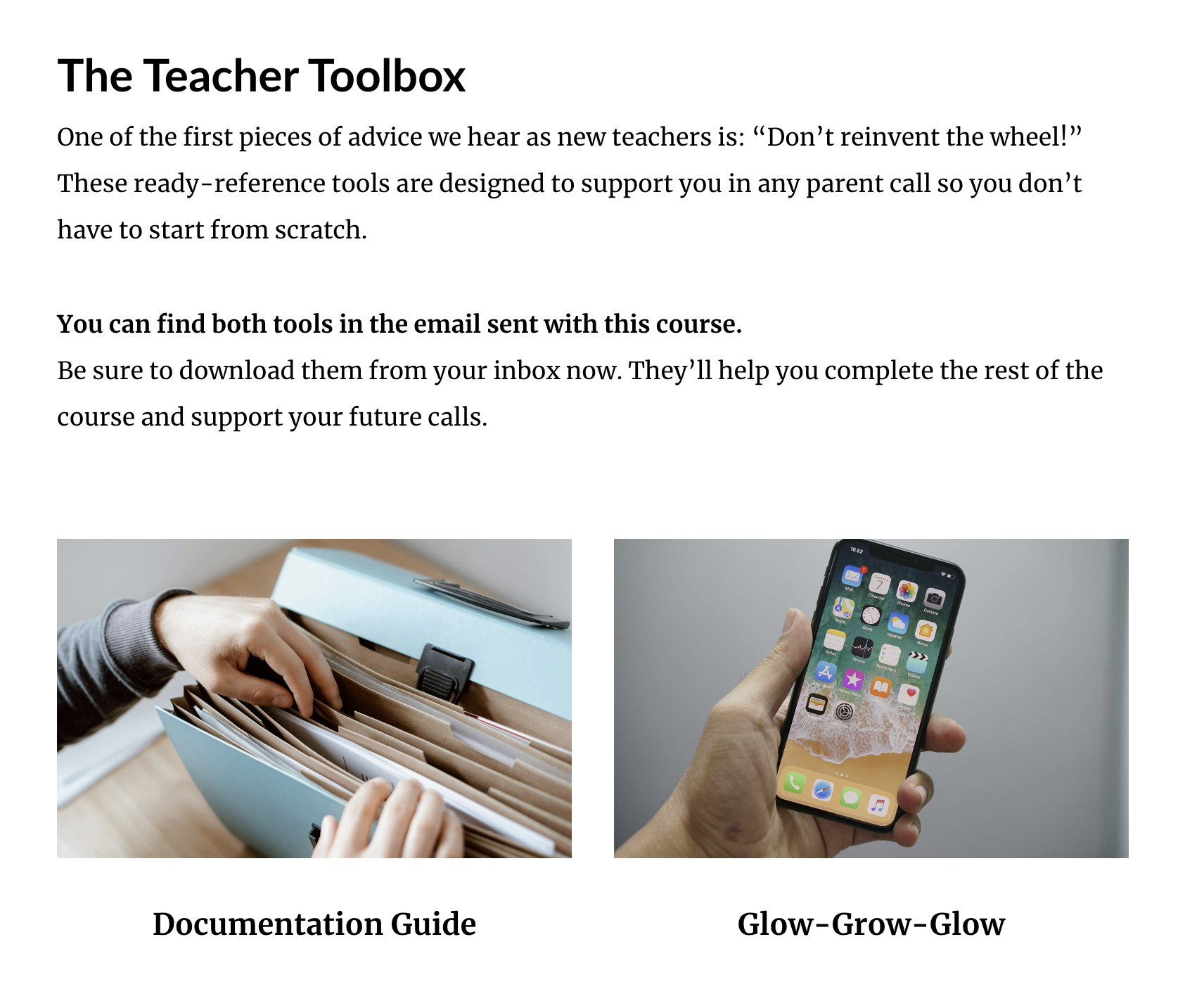
A sample screen inviting the learner to download their provided job aids to use within the rest of the course and their work.
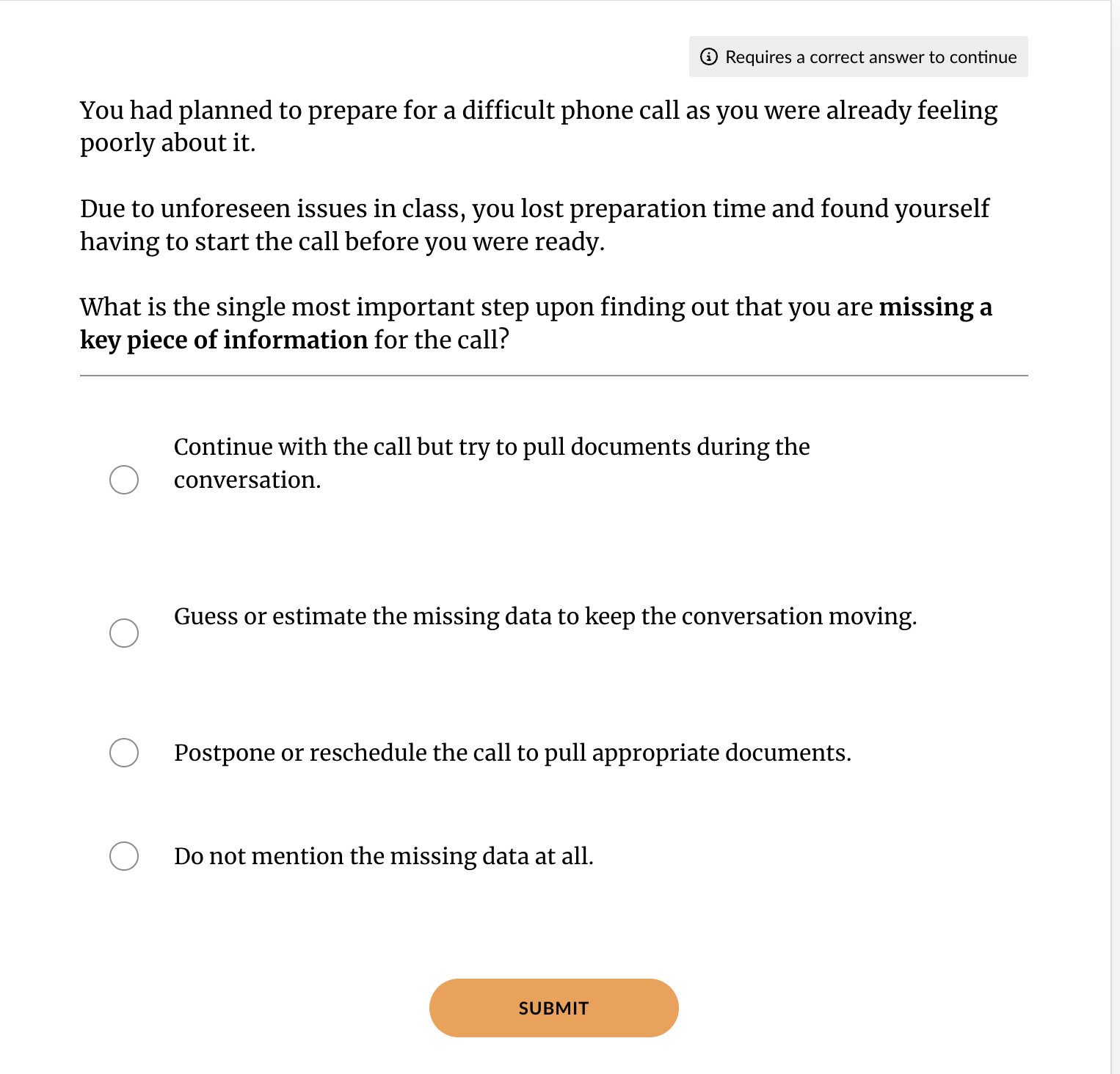
To validate the realism and practicality of the training, the course underwent peer review by three educators representing both elementary and secondary contexts. Reviewers confirmed that the communication scenarios and strategies accurately reflected common classroom experiences and required minimal revisions.
A sample assessment item at the end of a course module.
Evaluation & Impact
Evaluation was structured using Kirkpatrick Levels 2–4 to measure both learning and real-world performance outcomes.
Level 2 - Learning
Learning was assessed through embedded knowledge checks, scenario responses, and reflection prompts designed to measure comprehension, application, and shifts in communication mindset.
Rather than relying on a traditional high-stakes quiz, the course uses scenario-based interactions and feedback loops to ensure learners actively engage with the communication framework and practice applying strategies in realistic situations.
Level 3 - Behavior
Three months after course completion, a follow-up survey measured changes in communication practices among participating teachers.
Results indicated measurable changes in communication behavior:
Teachers using phone calls as their primary communication method increased from 14% to 24%
Teachers making at least one proactive phone call per week increased from 21% to 41%
Over 50% of participants reported using at least one communication strategy introduced in the course
These results suggest increased consistency in proactive teacher–family communication.
Level 4 - Results
To evaluate the broader impact of the training, a survey was distributed to parents of students in participating teachers’ classrooms three months after course completion.
Parent responses, measured using a Likert scale, indicated positive perceptions of communication quality:
Clarity and Proactive Effort: 76% of parents agreed communication was clear and proactive
Positive Tone: 80% agreed communication was constructive and supportive
Trust and Partnership: 73% agreed communication strengthened collaboration with the school
These results indicate that improved communication practices contributed to stronger school–family partnerships.