
Fresh Starts:
Getting Market Ready with Oakwood Acre & Table
This scenario-based onboarding course was designed for Oakwood Acre & Table, a fictional community-focused farmers market. The training prepares new and returning vendors to operate successfully within the market environment by clarifying expectations around safety, logistics, product presentation, and customer engagement.
Audience: Farmers Market Vendors, new and existing
Responsibilities: Instructional Design, eLearning Development, Scenario Design, Visual Design, Assessment Design
Tools Used: Articulate Rise, Canva, Unsplash, ChatGPT, Google Gemini
Note: This project is a simulated training course created for portfolio demonstration purposes. Evaluation data reflects modeled outcomes based on realistic performance benchmarks.

The Problem
Farmers markets rely on vendors to independently manage product safety, booth presentation, and customer interactions while adhering to market policies. However, onboarding information is often delivered through static documents or brief orientation sessions that do not fully prepare vendors for real-world operational challenges.
Without structured onboarding, vendors may struggle with compliance requirements, booth organization, and customer engagement practices. These gaps can lead to inconsistent vendor experiences, operational inefficiencies, and missed opportunities for customer connection.
The goal of this project was to design an onboarding experience that would clearly communicate operational expectations while helping vendors build the practical skills needed to succeed during a market day.
The Solution
The course was developed in Articulate Rise to ensure accessibility across devices and allow vendors to complete the training at their convenience prior to participating in the market. Content was organized into three action-oriented modules reflecting the natural workflow of a market event:
Prepare
This section focuses on pre-market logistics, including product labeling requirements, safe food handling practices, and temperature-controlled transportation. Vendors learn how to prepare inventory and documentation before arriving at the market.
Sell
This section addresses the vendor–customer experience, including booth layout strategies, visual merchandising, and customer engagement techniques designed to create an inviting and professional market presence.
Sustain
This section focuses on end-of-day procedures such as efficient booth breakdown, waste management, and strategies for maintaining customer relationships after the market, including the use of QR codes for feedback and mailing list sign-ups.

A sample screen sharing information with learners on proper customer service interactions.
To move beyond passive content consumption, the course incorporates interactive scenarios and decision-based activities that allow vendors to apply operational guidelines in realistic situations. For example, one scenario asks vendors to respond to a customer questioning product labeling requirements. Learners choose from several response options and receive immediate feedback explaining the most effective communication approach.

A sample screen for an interactive market label illustrating required information for all labels at Oakwood Acre & Table.
These interactions encourage vendors to actively apply compliance standards and customer service strategies while reinforcing Oakwood’s community-focused brand voice.
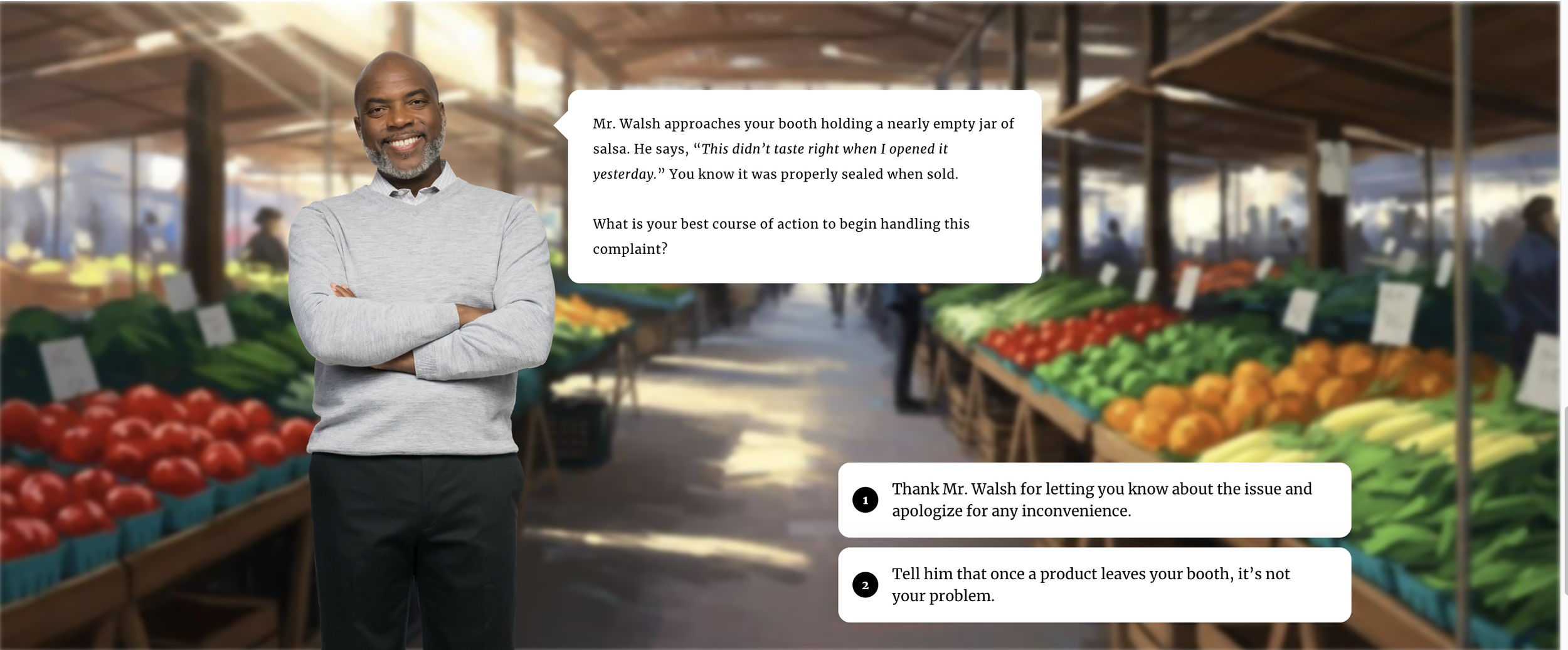
An interactive scenario-based informal assessment regarding a customer complaint.
Evaluation & Impact
Evaluation was structured using Kirkpatrick Levels 2–4 to measure both learning and real-world performance outcomes.
Level 2 - Learning
Learning was assessed through embedded knowledge checks, scenario-based responses, and interactive decision activities designed to measure comprehension and application of market policies and vendor best practices.
These formative interactions required vendors to apply operational standards within realistic market scenarios rather than relying on a traditional high-stakes final quiz.
This formative structure reinforced resource utilization and procedural reasoning, encouraging learners to reference official standards rather than relying on guesswork.
Level 3 - Behavior
Three months after the onboarding program was implemented, follow-up evaluation measured whether vendors were consistently applying Oakwood standards during market operations.
A vendor self-assessment survey measured confidence and frequency of applying course practices. Results indicated that over 80% of vendors reported regularly using the preparation and customer engagement strategies introduced in the training.
In addition, market coordinators used an observation checklist aligned with course objectives to document vendor behaviors during market operations.
Observations indicated a 20% decrease in vendor non-compliance incidents compared to the previous market cycle.
Level 4 - Results
To evaluate broader market impact, data from Oakwood’s vendor QR code engagement system was analyzed three months after the training. Vendors were encouraged to display QR codes at their booths to support customer engagement and collect feedback.
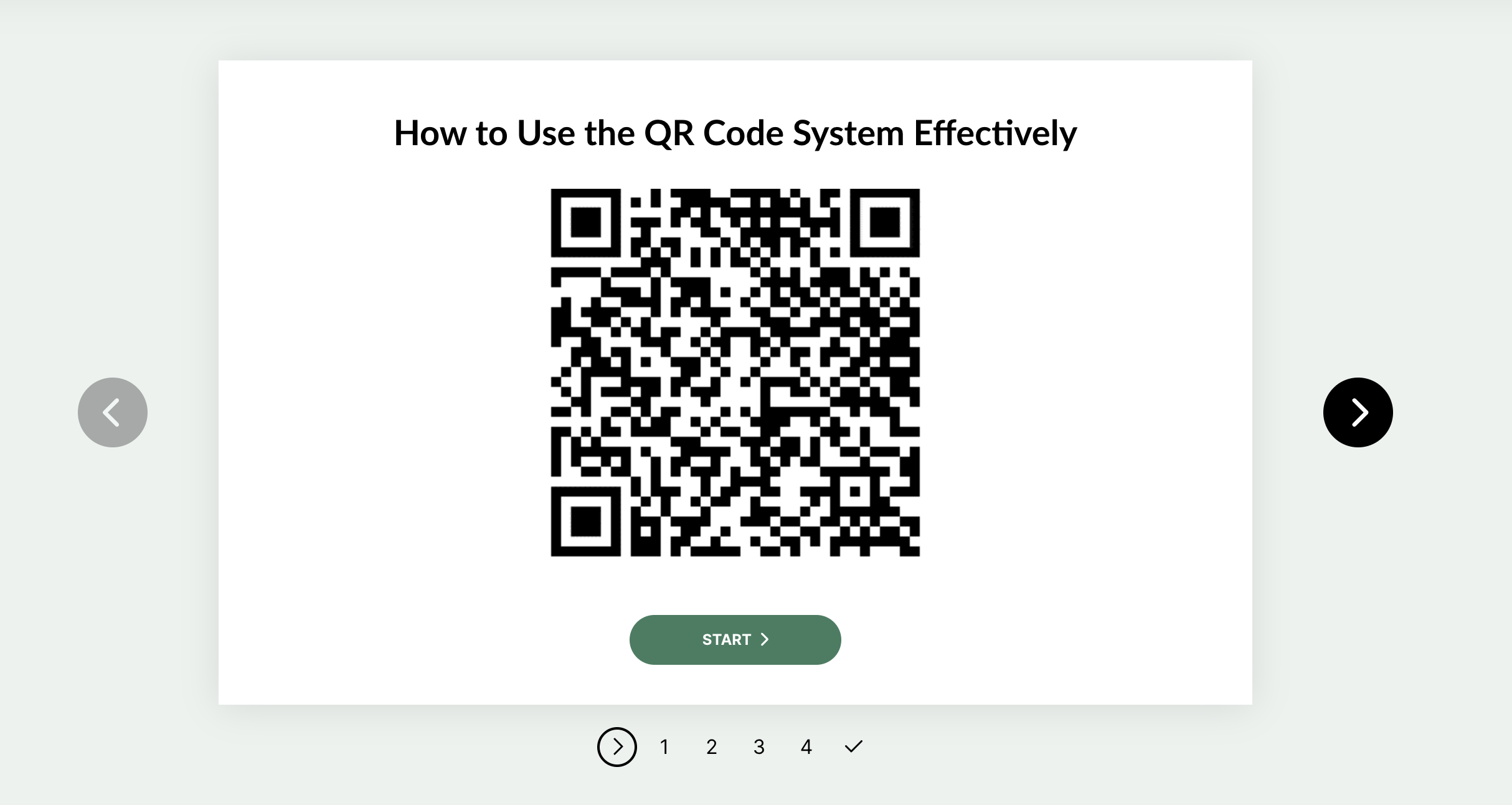
A sample screen for a process block explaining to learners how to utilize Oakwood’s QR customer feedback system.
Data analysis measured:
customer QR code scans
feedback submissions
email sign-ups for vendor mailing lists
Results indicated that:
40% of QR scans resulted in a feedback submission or email sign-up
overall QR usage increased by 25% compared to the previous market season
These results suggest that improved vendor preparedness and engagement strategies contributed to stronger vendor–customer interactions and increased participation in Oakwood’s digital engagement initiatives.